Atlanta has been the butt of fashion jokes for decades. From people clowning the city’s affection for logomania to others saying you can “tell when someone is from Atlanta by their outfit,” the critiques seem to get more ruthless as the years go on.
But those jokes often miss the point. Atlanta’s style has never been focused on restraint, but it has always been about visibility, aspiration, personality, and arrival. The city’s fashion sense is rooted in hip-hop, Black Southern culture, beauty, nightlife, entrepreneurship, and the pursuit of luxury on its own terms.
This is why The Real Housewives of Atlanta matters.
When the series premiered in 2008, it introduced the world to a new group of reality television stars. It gave viewers a weekly look at Atlanta women who knew a look could say just as much as a read.
RHOA was a decade-defining moment for the Black Mecca because each woman brought her own style language to the screen. Together, they helped make Atlanta fashion more visible, more legible, and much harder to dismiss.
Atlanta Had More Than One Fashion Language
Decades before the debut of the Real Housewives of Atlanta, Atlanta already had a layered aesthetic that reached across luxury retail, social dressing, boutique culture, music, nightlife, and celebrity image-making.
One of the earliest examples was Rich’s, the Atlanta department store based in the city, where Sol Kent brought the top luxury labels to the Peach State during his time as fashion director and through his event, Fashionata. In doing so, Kent showed there was a market for top-priced luxury labels in Atlanta. This fashion extravaganza mattered because it showed Atlanta was not an outlier in fashion but a major market to capture. The city had shoppers, audiences, and institutions that understood fashion as both commerce and performance.
By 1969, Phipps Plaza had opened, cementing Atlanta’s Buckhead neighborhood as a breeding ground for fashion. The mall opened with anchors such as Saks Fifth Avenue and Lord & Taylor, giving the city a retail environment in which luxury and aspiration could coexist. Even before Phipps housed the European fashion labels it is associated with today, it helped establish Atlanta as a serious shopping city in the South.
But Atlanta’s fashion scene revolves around more than just department stores.
In the ’90s and 2000s, Atlanta style was shifting into an amalgam of fashion influences. There was the hip-hop and music-video side: denim, hair, glam, clubwear, sneakers, jewelry, and body-conscious silhouettes. There was the special-occasion side: weddings, galas, charity events, pageants, and dresses made for women who wanted to be seen. And there was the boutique and street-style side, where stores like Walter’s, HollyHood, Psycho Sisters, and Junkman’s Daughter helped form a more individual, expressive Atlanta look.
That range is important. Before RHOA, Atlanta style wasn’t a single clean look. It was layered and could be polished, glamorous, flashy, feminine, experimental, formal, or rooted in hip-hop culture, even simultaneously.
By this time, the city and the broader South had become staples of the Southern fashion landscape, producing and shaping creatives such as Patrick Kelly, Sergio Hudson, and Wes Gordon. The city had a sharp, southern style code that instantly read as being outlandish, cohesive, a spectacle, and vibrant. That influence also stretches beyond the city limits and appears on some of the world’s most famous runways.
It often goes understated how much of Atlanta’s culture is built around celebrity style and this proximity to what luxury means. When you think about it, the city has forged some of the world’s most noted talent, including Raven Symoné, Ciara, Outkast, TLC, Fonzworth Bentley, and more. This was the microcosm of culture, taste, and style in which Atlanta was developed.
So by the time Bravo cameras started rolling in 2008, Atlanta already had a key fashion code. RHOA didn’t necessarily invent our taste, but the show displayed it by showing a city where clothes were already tied to ambition, visibility, beauty, status, and performance, then turned that language into television.
RHOA Turned Style Into Character
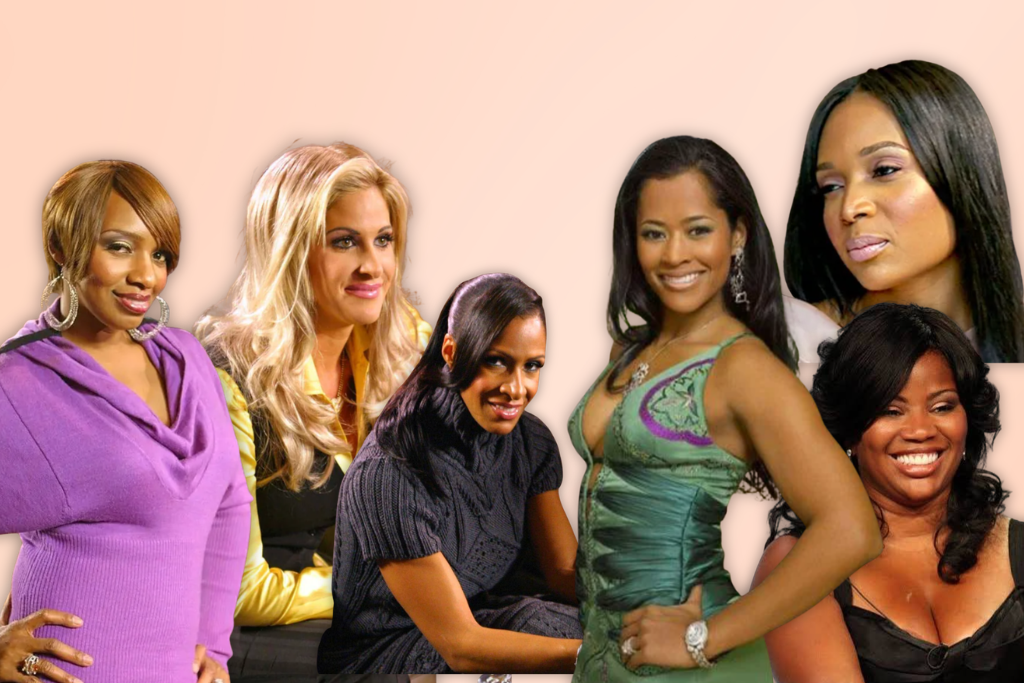
When The Real Housewives of Atlanta debuted on Oct. 7, 2008, its first peach-holding lineup included Linnethia “Nene” Leakes, Kim Zolciak, Shereé Whitfield, Lisa Wu-Hartwell, and DeShawn Snow. Together, the women introduced viewers to different archetypes of the Atlanta woman.
There was Shereé, the exclusive fashion girl with a designer’s ambition. Kim, the big-spending blonde who treated luxury like a lifestyle requirement. Nene, the personality dresser whose clothes often matched her presence. Lisa, the chameleon, moved between jewelry, fashion, fitness, and family life. And DeShawn, the classic Southern woman, whose style leaned more polished, formal, and social-circle appropriate.
The most important aspect of the first season is that the show translated different versions of Atlanta womanhood through clothing, beauty, status, and self-presentation.
Within the first season, Shereé announced to the world she was creating her own fashion line—She by Sheree—which would go on to actually have a runway show in season 2 after the first season’s blunder, although it is now relegated to joggers and athleisure. Also, in season two, Lisa Wu added another layer with Wu Girls, her jewelry line, and later with Closet Freak, her fashion line. This would become a point of tension between her and Shereé, but it also showed how deeply fashion and entrepreneurship were already embedded in the show’s DNA.
Then there was Kim, who represented another side of Atlanta luxury culture: the woman who shopped as if life were short and labels were part of the fantasy. Her now-famous line — “I can die tomorrow. I’m gonna die wearing Dior” — conveyed something essential about the show’s early fashion language and how clothes were used to display access, aspiration, and being seen.
Later, Cynthia Bailey would expand that language even further, bringing model polish and fashion-industry credibility to a show already fluent in glamour, status, and self-presentation.
The show’s early success gave viewers a clearer sense of what Atlanta had to offer.
The Real Fashion Story Was Visibility
The name of the game for this show was visibility.
Before the show, Atlanta’s fashion culture already existed locally, across multiple scenes and outside the dominant fashion press: in music videos, boutiques, malls, salons, galas, weddings, nightlife, and celebrity image-making. But RHOA gave the culture something different. It gave it repetition.
Every week, viewers watched Atlanta women get dressed for brunches, charity events, fashion shows, cast trips, launch parties, confessionals, and social gatherings. The clothes helped explain the social world they were moving through and how they styled themselves for these moments.
On RHOA, fashion became a language of status. It told viewers who had access, who wanted access, who understood luxury, who was performing wealth, and who knew how to make a moment. A designer bag, a dramatic gown, a boutique event, or a reunion look could say as much as a confessional ensemble.
That made the show so important to Atlanta fashion. It turned local style codes into recurring television grammar.
The hair, the labels, the glam, the heels, the gowns, the shopping, the fashion businesses, the entrances — all of it taught viewers how to read Atlanta style. And over time, the city’s fashion identity became more legible to people outside of it.
RHOA communicated how ambition, personality, status, humor, rivalry, and power all thrive within the city.
Marlo Changed the Fashion Conversation of The Real Housewives of Atlanta
Marlo made fashion literacy part of the show, including knowing labels, styling references, collecting pieces, and using luxury as a form of social language.
Originally from St. Petersburg, Florida, Marlo made a splash on the Real Housewives of Atlanta scene in season 4. Marlo joined RHOA in season 4 as a friend of the show and became closely associated with Nene. Nene and Marlo were a match made in fashion heaven. As Nene once said, “I’m a shoe girl, Marlo’s a shoe girl. I’m 5’10, Marlo’s 5’10. When I walk into a room, I own it. When she walks into a room, she almost owns it, so we’re a great pair!”
With Marlo, viewers gained a clear point of view of how luxurious Atlanta’s fashion circles can be. When Marlo stepped onto our screens, her image quickly became associated with Christian Louboutins, Chanel bags, Louis Vuitton, and all the “fabulosity” she would introduce to the Housewives, highlighting a range of fashion sensibilities among the ladies in the group and the city overall.
Marlo’s penchant for luxury impressed many viewers. She came from a fashion background, having owned her own fashion boutique, The Red Carpet Boutique, in the city. Later, in 2020, she opened Le’ Archive, which is an exclusive luxury rental showroom. With RHOA, Marlo brought a very specific version of Atlanta luxury fashion to the mainstage.
In a way, Marlo represents one version of Atlanta luxury where fashion is about access, knowledge, aspiration, and being seen.
Why It Still Matters
The Real Housewives of Atlanta created a recurring visual language that would go on to define Atlanta style for years to come. Through the cast’s personal style, the show became a visual archive of the city’s fashion ecosystem — the hair, the labels, the reunions, the boutiques, the entrances, and the ambition.
Before RHOA captivated our screens, Atlanta already had a style code and an aura that was inescapable. The women simply amplified it, showing the world that Atlanta fashion had its own rules.
Since 2008, the cast has been able to set trends and make waves both within the city and on television, showcasing Atlanta’s ingenuity, creativity, and sense of self-expression.
The Real Housewives of Atlanta did not make Atlanta stylish, but it made Atlanta style undeniable.
Leave a Reply