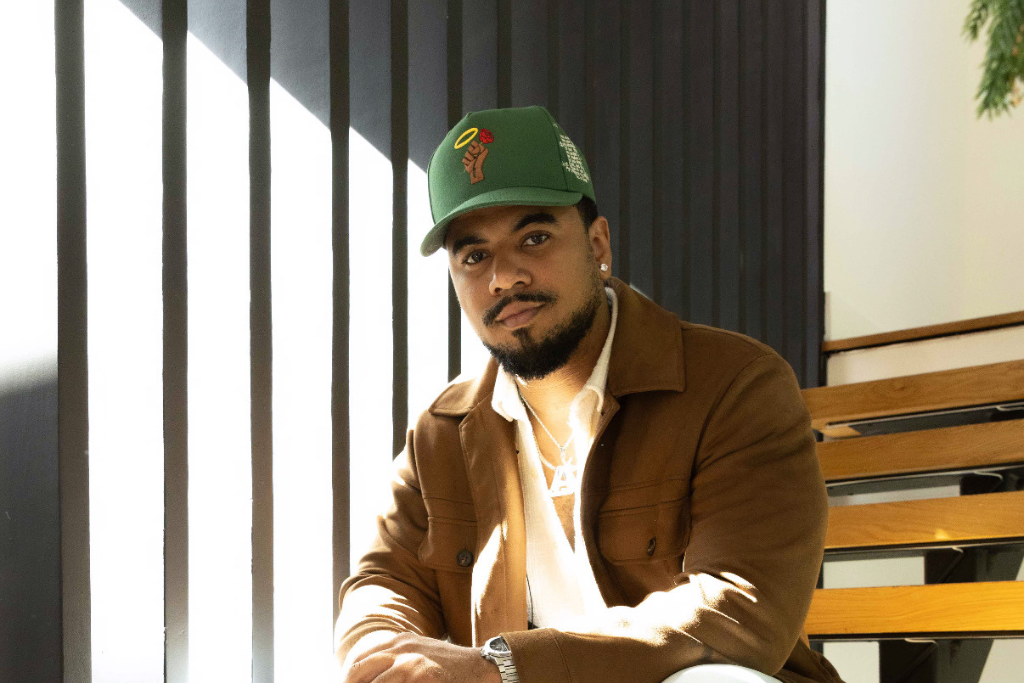
Julian Horton is thinking beyond the role that made more people pay attention to him.
The Philadelphia-born, Atlanta-raised actor has become widely recognized for playing Roy Bellarie on Tyler Perry’s “Beauty in Black,” a character whose audacity, volatility, and absurdity make him nearly impossible to look away from. But Horton is not interested in letting one role define the full scope of what he is building.
Off-screen, Horton is moving as a multi-hyphenate: actor, musician, producer, and founder of Julitine Pictures. As rapper J12, he has released “Gon’ Head Buss It,” a single with Erica Banks that has earned 1.1 million views on YouTube as of this writing. His ambitions extend beyond visibility and into ownership, originality, and creating work that can outlast a single breakout moment. For Horton, the goal is to be seen, to build, to own, and to keep expanding.

That feeling of purpose is rooted in Atlanta, a city he credits with shaping his humility, range, and refusal to perform anyone else’s version of cool. It also shows up in the way he talks about faith, emotional openness, personal style, and the discipline required to create opportunities instead of waiting for them.
The Sitch spoke with Horton about Roy’s freedom, the Atlanta influence that formed him, how he defines originality, and why ownership has become essential to the future he is building.
Roy is audacious, rowdy, absurd, and somehow impossible to look away from on Beauty in Black. What do you think people are really responding to when they connect with him?
People are moved by audacious things. Roy has the audacity to do outrageous things that other people may think about, but would never actually do. At the same time, Roy is a spectacle. He brings so many different emotions to the show — viciousness, humor, trauma, sadness, and even the healing he still needs.
I think people connect with Roy’s freedom. Nowadays, we’re addicted to shock value. We’re addicted to craziness and turmoil, and Roy embodies all of that.
Your approach to acting seems rooted in healing and self-awareness. What did Roy pull out of you personally?
Personally, it made me more aware of my decision-making and how I make people feel. Playing a character who is so unsympathetic, vulgar, and downtrodden forces you to step into that space and convey those emotions.
On the back end, as Julian playing Roy, I wanted to be nicer to people. It gave me even more empathy and kindness. I already think I’m an empathetic and kind person, but Roy opened me up to that even more. Since Roy doesn’t do that, it made me want to do the opposite.
A lot of men are taught to suppress emotion, but your performance doesn’t run away from vulnerability. Was emotional openness something you had to unlearn, or has that always been part of you?
No, I think that’s one of my strong suits as a man and as a human being. I’ve always been emotional, and I’ve never been afraid to show that. As a kid, I dealt with anxiety, intrusive thoughts, depression, fear, and doubt, and I learned early that bottling those things in only makes them worse.
I learned to talk to God, my family, and my friends about what I was going through. A lot of people are afraid of being perceived a certain way, but I told myself young, ‘I don’t care what people think about me. I’m going to be the man God created me to be.‘
So no, I didn’t really have to unlearn vulnerability. I’ve always been able to express myself and say what I feel. By the grace of God, playing Roy wasn’t as challenging as some people might think, because everything I’ve gone through helped prepare me to get here.

You’re Philadelphia-born but Atlanta-raised. Did Atlanta shape your craft in ways that show up in how you move, perform, or see people?
Atlanta is a cultural hub full of love and camaraderie, and I definitely think that plays a part in my not being pretentious. Maybe it’s an Atlanta thing. You see people who have done great things and are still so connected to the culture. People, like T.I. and JID, who were around before I was even on the show have shown me love, kicked it with me, and talked to me like normal people.
I think that’s because we aren’t consumed with fame here. It’s not too Hollywood. Atlanta taught me not to be afraid of being myself, but also never to get too high on my horse. It taught me to stay humble and remember that we’re all on the same playing field. Atlanta definitely shaped me into being a well-rounded individual.
Now that more people are watching you, how are you thinking about personal style — not only in fashion, but also for the Julian Horton brand?
It goes back to originality for me. I wear what I feel comfortable in, and sometimes that’s the most ordinary stuff: a black shirt, black sweats, and some Forces.
Obviously, I like fashion and stepping out, but at the end of the day, I’m going to be myself. I don’t feel like I have to fit into anything or be conditioned to look like somebody else.
You founded Julitine Pictures—what made media ownership necessary to you at this point in your career?
It’s the current media climate. I feel bad for creators in every medium right now, because the algorithm and the way people consume media are so different from how they used to be. People aren’t giving out parts in film productions the way they used to, and I’m not going to wait on Hollywood to come through.
I learned from Tyler Perry to make your own seat at the table. With my music team, my label, and my production company, Julitine Pictures, I’m doing everything I can to create great content and put it out into the world.
Beauty in Black is amazing, and I’m grateful for it, but time is undefeated. People know me as Roy right now, but one day, it’ll be 2030, and people may not be talking about the show the same way they are today. That’s why ownership matters to me. It allows me to control the narrative, put out my own work, keep my career moving, and create more opportunities for myself and the people around me.

With TMO spanning music, fashion, and collaborations, how do you define originality in practice? What does that look like when you’re actually creating?
In practice, originality means being who God created you to be. That’s really it. God made everyone different, so nobody is exactly alike.
That’s why originality is so important to me. The people I surround myself with, and the person I am, we’re not trying to act like anybody else or fit into anything. We’re not trying to be too cool for school. We’re just being ourselves.
I’m not scared to be who I am completely. If I want to be goofy or animated, that’s who I’m going to be. I don’t care about looking too cool, because I believe God gives everybody something for a reason. I take pride in that.
If everything you’re building works the way you envision it, what does your career look like in five years?
I would say solidified as one of the greats. That’s what I really want for my life.
I look at people like Will Smith, Jamie Foxx, Denzel Washington, and Michael B. Jordan—Black men I’ve revered my whole life, who influenced me and inspired me to keep reaching for greatness. I want to build something in that same spirit.
I’m grateful for where I am right now, and truly, I do think Roy is an iconic character. I stepped into that role and went all the way with it. I put my foot in it and did everything I could to make him feel layered and memorable.
But beyond that, I want to keep building. I want to stay focused on what God says, keep honoring the gifts He gave me, and continue creating opportunities for others. In five years, I want people to look at my life and say, ‘God took him there.‘
Leave a Reply