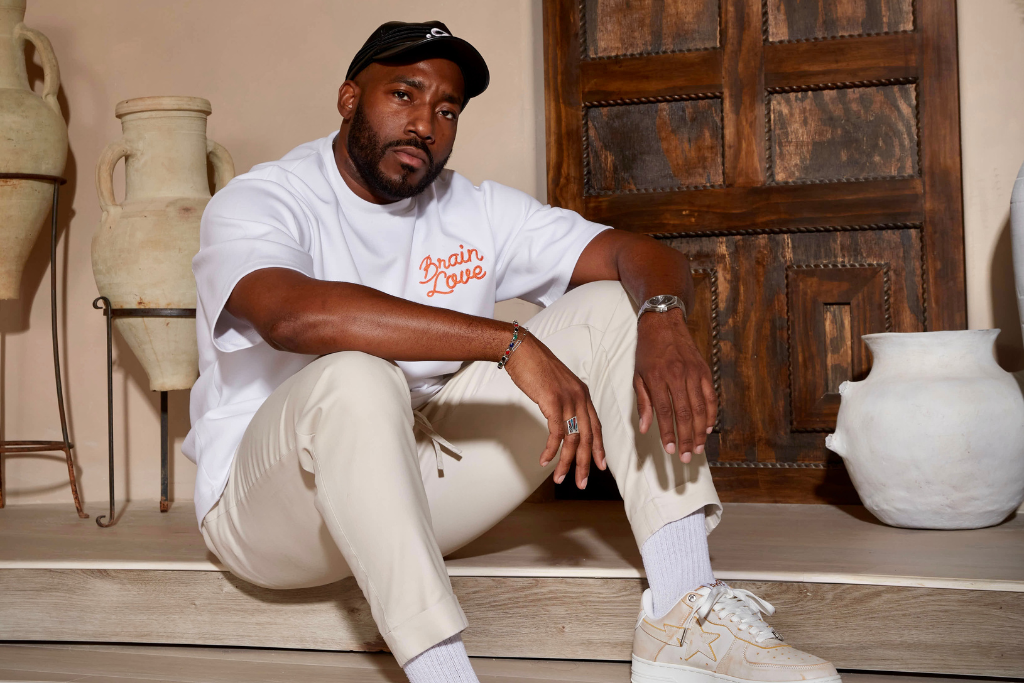
When Archie Clay III set out to create Brain Love, he was searching for a new medium for a deeply personal message: mental health could be urgent, aspirational, and wearable. Known for its eye-catching graphic tees and classic uniform shirt, the Atlanta-based brand has carved out a signature aesthetic rooted in cool refinement, community, and emotional honesty. Now stocked at Bloomingdale’s, fresh off a sold-out pop-up, and reportedly one of the top-performing SKUs at the retailer’s Lenox Square location, Brain Love is proving its resonance within Atlanta’s fashion scene and beyond.
Like much of The Sitch’s coverage on fashion, confidence, and identity, Brain Love is interested in what clothing can say before the wearer does.
The Sitch sat down with Clay to discuss the making of Brain Love, why the brand continues to connect with consumers, and what entrepreneurship has taught him about discipline, healing, and staying the course.

When did you realize mental health wasn’t something you wanted people to talk about quietly, but instead make it a cornerstone of your mission?
It started with my journey. I had a company called Wear Brims, and that was my first introduction to entrepreneurship. When that business ended, that was the first time I felt depressed and didn’t really know where I wanted to go next.
In that moment, I realized we have to take time to step back, look at ourselves in the mirror, and figure out what’s wrong. What’s keeping us from moving forward? For me, it resonated like, let’s create something that has a bigger impact than just clothes. Let’s create something that makes people feel truly special, or even prompts them to ask themselves, ‘Do you love yourself? Are you healed?’
What does making mental health wearable actually mean in practice?
It’s joyous. It’s happiness. It’s belonging. Even if you’re someone who may not be on the journey just yet, it gets you to think about wanting to be on the journey.
For us, it’s about connecting the quality and standards of luxury fashion back to what luxury truly is, which is whole body, whole mind, whole spirit. That is luxury. But it’s also okay to have the flyness on top of it.
It has to still be cool. It has to still be dope. That’s how we cut through the noise. If we have a shirt that says “healing” on the front, it’s not just a regular T-shirt. It’s something you feel proud to wear, captures your emotional journey, and helps tell your story.
Brain Love Laugh and Dance T-Shirt

Do people connect more to Brain Love because of how it looks or how it makes them feel?
I think it’s both. Customers come from different points of entry. Some people may see the craftsmanship and quality first. Others may come to the website, see the healing shirts, read the story, and connect with the mission.
But the retention of who we are is the story, the mission, and the values. We want people to feel like we’re putting time, effort, and attention into what the garment represents.
Do you see Brain Love as streetwear, or as something pushing fashion into a different space?
I don’t want to put us in a box. We are streetwear, contemporary, and we even make suits. It just depends on where we are.
Streetwear is just what you wear in the street. It became trendy, and people started using it from a capitalist perspective, but everything can be streetwear. It’s about how the customer styles it, how the garment speaks to them, and how they express themselves in it.
How do you make something rooted in mental health feel aspirational and not heavy?
Making it cool. At the root of it, people want to be cool. In fashion and consumer goods, you have to make the garment feel like something everybody wants.
Mental health is a touchy subject in our community. People talk about money and success, but nobody really likes to talk about the struggles. And even when they do talk about the struggles, they’re not always being truly honest about them.
I want to be a founder and CEO who is a man of faith, who is vocal about that, while still building something special and impactful. Community plays a major role in that. You can’t do it by yourself.

Why do you think Brain Love resonates so strongly right now?
I think it’s all generations. It’s something we’ve always wanted. We all have trials and tribulations that we’re going through every single day, and sometimes it feels like we’re alone in the journey.
We want the customer to know: you’re not alone. We’re going through it with you. Even when you get success, the journey doesn’t stop. Just because you got money doesn’t mean that you’re free.
How do you think about success, especially as an entrepreneur building a brand with purpose?
Being a better version of yourself is not just about getting money. Everybody can get money. You’ve got people who get money and are horrible people.
The question is, how do you become a better person? How do you become a better family member and loved one? That’s true richness.
The whole purpose of being a boss is to create your own time, not to choose to be away from your family. That’s crazy to me.
When someone wears Brain Love, what do you want it to say about them immediately?
They want to evolve. They want to achieve greatness and be happy.
People want to build something not just for themselves, but for others around them. It’s not just about me or you. It’s about how we continue to pull people up. Two things can be true: we can do good work in the community and create a dope product.

What do you want people to take from Brain Love beyond the clothing?
Be okay with the journey. I know it’s hard. There are moments of tears, moments of sadness, moments of doubt. I’ve had it all. That’s natural.
The question is: how do you keep going forward? That comes with willpower, resilience, and being honest with yourself. You can say, ‘I’m not okay with this situation,” or “I’m still hurt from this situation.’ Those emotions are okay to feel, but they don’t have to control who you are as a person.
Leave a Reply