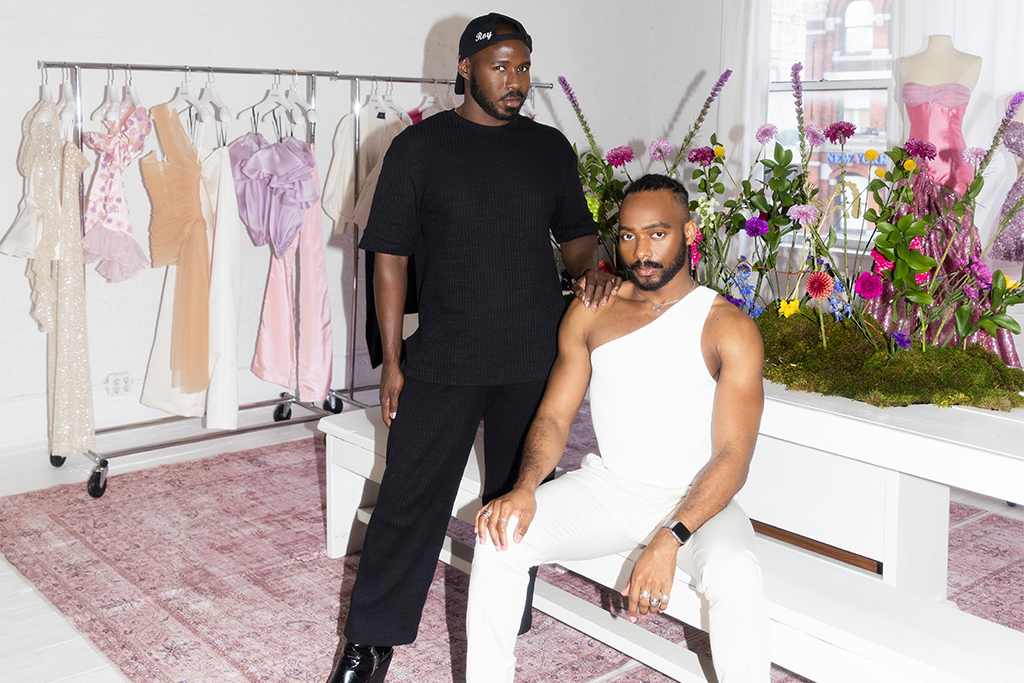
In today’s fastidious fashion landscape of fleeting social media trends — often unremembered as quickly as they come into syndication — JEOFROI, the brainchild of Jeffrey and Roy, sticks out amongst the clutter due to its commitment to crafting luxury, made-to-order fashion pieces that will become closet staples for years to come. From the duo being a trio alongside Christopher John Rogers on the cutting room floor of SCAD’s fashion design department to the two charting their path within the Atlanta fashion scene and beyond, JEOFROI is a force to recognize — full stop. The brand is known for its ethereal essence and sweetness, coaxing its customers to escape into their chicly-clad fantasy while bolstering the reputation for Southern design and tradition. We met with Jeffrey and Roy to discuss the challenges designers face in Atlanta, how to create progress and equity in fashion, and why developing personal style is crucial.
Jacorey: Hi Jeffrey and Roy, it’s so nice to finally sit down with you. I’m a huge fan of your work and how your work exudes a southern sensibility that’s both sexy and fun. Can you both tell me about your upbringing and how fashion was pivotal in your life?
J: As a little boy, I’ve always been fascinated with my mother’s clothing. I grew up in a religious household, with my mom being a first lady. So, she was dressed to impress for every Sunday church service we had — I was always fascinated with that. But I think my love for fashion came about when the “Cinderella” (1995) movie debuted with Whitney Houston and Brandy, and I saw beautiful black women in beautiful gowns. From then on, I started to redraw the gowns I saw in the movie. I started to ask my mom for her fashion magazines and tried to re-sketch things I saw in the magazine. My journey started at a very young age.
R: For myself, similar to Jeffrey, I’m from New York, upstate New York. My mom was the first African-American female mayor in the state of New York — and I’ve always watched her use clothing to sway her constituents. I would start to get ready for school looking kind of crazy. And then, she would go in the bathroom, do her makeup, go in her closet, get dressed, and she would come out a completely different person. And I was like, “This transformation is sick. This is something I want to do. This is something I want to be a part of.” That was a pivotal moment for me being a part of fashion and something that guided me in this journey of fashion.
Jacorey: For me growing up, Beyoncé and Sandra Clark on 227 were some of my favorite style icons. Who were some of your favorite style icons growing up?
R: For myself, I never looked to specific people. I was young. It’s like, I loved Britney Spears and Christina Aguilera, so I was drawing a lot of those looks. But I was always inspired by Disney princesses. That was the energy for me always.
J: I would definitely add on to that. I don’t think I knew what a style icon was growing up until I got more into middle school, high school. But I pulled a lot of inspiration from looking at Mary Kate and Ashley and all of their shows. I loved every yearly Holiday Barbie that came out. I was always looking to see what she was wearing (I loved anything pageant in essence growing up).
R: And I would also even lean into, specifically Brandy. The “Cinderella” moment was iconic, because for us, that was the first black Disney princess. When you saw Brandy, and also the moment of how big Brandy was, I was like, “I need box braids. What do we do? How are we doing this?” I would definitely say, heavy on Brandy. Also, sorry to continue to go on, but in Moesha, she was giving moments.
Jacorey: I agree. Brandy is very pivotal, and I like how you both brought up Cinderella. Because growing up, I think about it now, and I look back in wonderment at how Black people had programming catered towards us on live television back in the day, and now, it’s been crickets. It’s unfortunate.
But pivoting a bit, I’ve always wanted to go to SCAD — but my mom said no. What was your college experience like, and how did you both develop as designers through your courses?
J: I love SCAD, because they had all the resources you could ever imagine. If you wanted to print fabrication, if you wanted to learn how to do technical draping or flat pattern, they literally had everything. Attending SCAD just felt right. Being in an environment filled with artists, and people that wanted to produce beautiful clothing, I think it was always inspiring to me. Meeting people like Chris [Christopher John Rogers] and Roy broadened my whole mind and how I was designing — it definitely worked in my favor.
R: For me, I went to school a little bit late, so I worked in the industry. I was working at Valentino. I got inspired, and said to myself, “Okay, I’m going back to school.” I was 24, going on 25 when I decided to go back. And it was very weird for me to experience people who had tried to be designers attempting to tell me how to design, yet they had never made it. For me, being a little bit older and more vocal, and understanding this is something my parents are paying for, I went into it more as this is a ‘transaction.’
But I was very lucky to meet people like Jeffrey, to meet people like Christopher John Rogers, who were saying, “Girl, you know what you’re doing and stick to what you love.” That is what got me through it, and it is also what made my college experience so beautiful. But to me, my biggest influence was Jeffrey and Chris, just in regards to the design side. I think without them both, I would have not enjoyed my SCAD experience.

Jacorey: In today’s climate, it’s necessary we hear the stories about Black folks attending art school and still pursuing their dreams — which often leads to amazing results. Speaking of your talents, what was the vision when you two decided to start JEOFROI? How did you know you wanted to be in the fashion business together?
R: I worked in corporate fashion, and I went to Gucci. I was at Panerai — the watch company. I was in a crazy relationship and Jeffrey came to visit me one time (and he read me and got me back on track). I love my friends, and I think I wanted to be in a space similar to what we had created in school. I also loved Jeffrey’s aesthetic. I had never seen someone come up with something and be able to drape it. When I tell you my good friend can drape, like it is nobody’s business…That was so inspiring to me. So, first thing’s first, I needed to move.
I thought, ‘I’m getting the fuck out of New York. I’m going to Atlanta.’ My mom has been here for 20 years. I reached out to Jeffrey and said, “Jen,” (because I call him Jen), and I said, “Jen, I think we should start a brand together. Our aesthetics mirror each other. We respect each other. I love what you do, you love what I do. You are kind of quiet and reserved, I’m kind of loud and obnoxious. This is giving ‘synergy.’ I was literally at work, I’ll never forget. He went and meditated and prayed on it and came back to say, ‘Let’s do it.’
J: I was trying to do my own thing, because I was working. I gave up a job after graduation to do the Supima design competition. Shortly thereafter, I moved back to Atlanta and started building up my clientele. I was doing well with my gowns here and there. Then, Roy called me talking about starting a new business. After meditating and praying about it, it was like two great minds coming together, and again, just forming something beyond which we had at the time. As Roy said, Roy brings so many amazing qualities to JEOFROI— the writing, the visions, the ideas — it is just so mind-blowing. When we come together and we’re developing a collection, we’re gagged, we’re quiet. Because we think, “How did we even get this far?” And this is just the beginning.
Jacorey: That’s a great point you made about the duo aspect. When I met you two, that’s what reeled me in the most: the camaraderie and kinship you two have forged is beyond amazing. Pivoting more to the aesthetic of the brand and the vision, why did you two decide to take the couture, made-to-order, route with JEOFROI instead of a more accessible, ready to wear iteration?
R: It’s what we do best, it’s what we know. Anybody can slap two side seams on a jersey dress and sell it for $10, and I’m not knocking the girls who are doing that because their checks are clearing, honey. I will never knock it. But for us, that is not something we’re good at. We’re not fast fashion girls ourselves. Jeffrey and I both have luxury retail backgrounds. We love quality, we love clothes that do the work for us, (because we pay for them). That’s important to us.

We idolize fashion moments that have transpired, the Mugler and the Valentinos, and all of these beautiful things. But society is trying to dumb them down, and that’s not what those iconic moments were. Fashion is an art. Fashion is studied. Fashion is something that’s developed and takes time. But when you make it fast, it’s like, “Okay, I mean cool, that’s cute. Love that.” Consequently, it’s like is that everything you could have ever dreamed about?
J: We are figuring out a way to navigate with how the world is turning to fashion right now and how things are working in the industry. But again, we want to make sure we never stray away from our brand codes and the model of JEOFROI we built from the ground up. Moreover, it is a learning process we’re going through — and it’s good to have Roy as my partner to go through it. Because again, we say it to each other all the time, “Girl, I don’t know how I could do this without you.”
Jacorey: I love to see it — a very wholesome answer. I love the chemistry between the two and it’s like a yin and yang situation. Speaking more about fashion labels in Atlanta, as a luxury couture minded fashion label operating in Atlanta, what are some of the biggest challenges you face currently?
R: I think some of the biggest challenges are getting people to recognize there are beautiful, amazing fashion brands and talents outside of New York and Los Angeles. There are beautiful people doing beautiful things, and they just can’t afford to live in New York or they don’t have the access to be in New York.
Jacorey: That’s a good point.
R: In my opinion, that is one of the biggest hurdles or issues. It’s very odd to me because we always glamorize these Basquiat moments or Halston ideals, but putting it plainly, to live in the apartment Halston was living in during the time he was living there, it wasn’t $4,000, and he didn’t have eight roommates. Of course you can be creative when you have space, money and all of the things.
J: One reason why we chose Atlanta is the wealth of opportunity and money here. Roy has touched on this before, but there are so many creatives here. We’ve met so many amazing, talented people here in Atlanta that we’ve worked with who could rival the people in New York. They know they get it [fashion]. They’re not distracted by the rush or the chaotic lifestyle of their environments.
Jacorey: Ditto. People sleep in Atlanta because we don’t have the technical “fashion instructure” in place to gain mass appeal, but it’s often interesting to me how tons of fashion’s big talent came from the south — especially Atlanta.
In terms of fashion in Atlanta, and the South overall, how do you feel about the aesthetic of the modern Southern woman? Would you change some things, or not? On Twitter, of all places, people constantly say, “Atlanta is nothing but stripper culture. They don’t wear real clothing.” But they’re not around the right people in Atlanta (from what I can see).
J: I would agree to disagree. You have to know the right people. We’ve had clients from Atlanta that come in and shop for galas, and they’re shopping to travel with their families. They’re shopping to host beautiful dinner parties. They’re shopping just to shop. But they don’t get all the attention a girl on a stripper pole will. There still are women here shopping for glamorous pieces, outside of the stereotype people have about Atlanta.
R: I’m going to chime in and say it’s weird, right? Because it’s like when you see a look on a stripper, you’re thinking, “Oh, my God, it’s a stripper wearing something stringy.” But when you see the same thing on people like Kim Kardashian, we love it, but it’s essentially the same look. But it’s just stripper culture here, but once it gets to you, it’s fashion? No. Black women in general have always set the standard. Then they take what we’re doing, they put it on somebody else, they make the hair a little bit bigger, change the eye color, and then they call it fashion. There’s things that I feel could be more tasteful, but I also am not in the business of telling women, specifically black women, what they should be doing.
Jacorey: You both made great points. Outsiders think people in Atlanta are beneath the fashion conversation, or can’t comprehend fashion — and it couldn’t be further from the truth. As black queer fashion designers in the South, do you think the industry is open to brands of background similar to yours?
R: It’s getting there, but getting there is not good enough — seeing as we’ve been around since the dawn of time and everybody steals everything from black culture. Also, seeing that every black person you meet in New York is from Atlanta or from South Carolina or from other southern places. It’s weird that we are not further along. They [the industry] want to be more inclusive, but oftentimes, we’re seen as a monolith in fashion. That’s something we’re even experiencing. People, even our own people, want to kind of put us in this weird box. Do I think it’s more inclusive? Sure. Do I think it’s as inclusive as it should be? Not at all. If fashion wants to survive, its beauty needs to include everyone.

Jacorey: Another interesting perspective.
R: Because it’s like, these things they’re featuring and people they’re featuring, and the celebrities they continue to feature — it’s starting to become a disconnect with what we’re all going through. And not disconnected in a beautiful way, like, “Oh, two black men from Atlanta are developing beautiful clothes,” but disconnected in a, we’re seeing rich people do rich things, and we’re saying, “Weird.” How much longer can we stomach this?
J: And it makes it harder for us when we continue to see it.
Jacorey: I agree with those sentiments. Fashion has to be inclusive to make a greater statement and appreciation for art, culture and beauty — it’s essential at this point. Celebs like Keke Palmer, Shirley Ralph and Law Roach — I love them all so much — have donned your creations. What is it like working with celeb talent? And what are some of your favorite moments so far?
J: Well, I can start off with our favorite moment. It would probably be dressing Rawdah Mohamed — correct me if I’m wrong, Roy.
R: I would say that was our favorite moment.
J: She was the editor in chief of Vogue Scandinavia for about two to three years.
R: But she’s also well known for Hands Off My Hijab! Movement. Which started in Paris back when they tried to outlaw women from wearing hijabs in public.
J: We had the honor of being featured in the first Vogue Scandinavia issue with her, and made a custom dress for her to wear to the Venice Film Festival. This was all within the first year of JEOFROI. We debuted in August and this happened in September.
Jacorey: That’s a good sign — you start the brand and a month later, this amazing opportunity drops into your lap. You two are doing what you’re supposed to be doing. That made me smile, because I love when things align. It’s divine timing. Alternatively, it’s almost fashion month — what are some trends, fabrics, silhouettes, do you see trending for fall and winter? And what do you hope stays and what goes? In my opinion, plenty needs to go.
J: I hope the trends die.
R: I hope so, too.
J: I hope they crash and burn. I want the girls to be who they are. I curse the day they were born.
R: Very much that. I want the girls to be who they are. What is the trend? Be who you are. We want to see what makes you feel good. We want to see what looks good on you. We want to see what doesn’t look good on you. Like, girl, turn looks. In short, kill the trends. They’re killing us. They have got to go.
J: The second part of your question was fabrications we want to see or either get rid of? I’m always here for anything heavily beaded or embroidered. So, more of that, please. But, ideally, I would love to see more solid color fabrications, beautiful silks and silk/cotton blends. Also, a sustainable way to produce fabric in a way where we can get the same quality but cleaner. I’m hoping that can be something new we see soon.
R: Heavy on that. We have so much technology — why are we not creating more sustainable ways to create things we already love?
Jacorey: I agree. The more simple pieces we get, so that we can…Or not simple, but the more we focus on personal style and we allow the clothes — as you both said earlier — to do the work for us, the further we’ll expand our depth and reach in fashion. I for one am tired of the TikTok trends and exhausted of Instagram telling us how to dress, for example, Tenniscore. When I saw it, I said, “Girl, a tennis skirt and sneakers. I’m not understanding.”
J: Tenniscore. I’m like, what is tenniscore? You mean a tennis outfit you’re going to wear to the tennis court? You’re putting on ballet fashion and you’re like, balletcore. No, this is a ballet show.
R: You’re about to lose your arch if you don’t put some real shoes on.
Jacorey: So, changing gears — if there were two or three things that needed to change within the current fashion landscape, more so specifically in Atlanta, or abroad — if you felt called to speak to them— what would they be?
R: I think more incubators — and not even just in regards to funding, but in regards to people understanding the depth of fashion. Often, people on Instagram think, ‘Okay, this is fashion.’ But it’s like, ‘Do you know what this is derived from? Do you know why this was created? Do you know the originator?’ And not even just in fashion, but that even carries over to art, architecture, so many different things inspire fashion. This wealth of knowledge is important because it allows you to pull from your references. We don’t need more of the same shit being funded. Atlanta has so much money, we could do our own thing and never have to interact with anyone. Atlanta is very much a trendy place, and I wish people would get out more to see the influences we have.
J: Very true. To add on, what I would like is more backing and resources for artists. I feel like a lot of people, as we said before, are leaving the South, Atlanta specifically, and going to New York, to LA, to all of these other cities that are juicing us of all our dreams, and then we’re burned out when we want to do our own thing. Having more backing, more resources or mentors, or just people looking to invest in any type of artist is important. If it’s not even a fashion designer. if it’s a painter, a sculptor — whatever it is, you have those resources.
Jacorey: This speaks to both of your domineering synergy, and I love it because people aren’t as candid and open as you two, so I love it. But for my last thought, I saw today on Instagram that the brand is teasing the volume 5 collection. What can we expect to see? What are the vibes giving?
J: Glamour. Crystals.
R: We try to outdo ourselves. We also are in a space of figuring out what people love, and sitting into that more. It’s like everybody loves the mounted flora. Okay, so how can we do the mounted flora and push it and make it bigger and better and more beautiful? We want to be a little bit sexier and dark. And we’re always very sweet, I hate to use the word sweet, but beautiful and floral. Yet it’s like, that could be sexy, too. Also, you can expect to see us changing up those colors and adding in some different textures and playing with beading. Moreover, it’s going to be a sexier, more fitted floral fantasy.
J: I would agree. And I think also just tapping into certain silhouettes that have worked perfectly for us within our years of being together, and working on them to enhance it even more. It’s sexier this season — bolder colors, heavier beading and embroidery. We just want to give you fantasy. We love a good fantasy.
Jacorey: So coming around the bend, where do you see JEOFROI going within the next five years?
J: We see JEOFROI being a thriving brand in tons of retail spaces. We see the story of JEOFROI being told all around the world while still maintaining a semblance of exclusivity. But also opening doors we never thought we would open, touching other people we probably never thought we could touch, or different markets, and continuing to blaze our path.
R: No, that’s something we discuss often, and yes, it’s very much the point. It’s being global, but at the same time, high end and not hyped.
Jacorey: I love to hear designers dreaming big dreams, and I know you two can do it! Thank you both for your time today, and I can’t wait to see all you accomplish with the brand.
Be sure to subscribe to our newsletter for more content like this and follow us on Instagram, Tik Tok and Facebook!
Leave a Reply