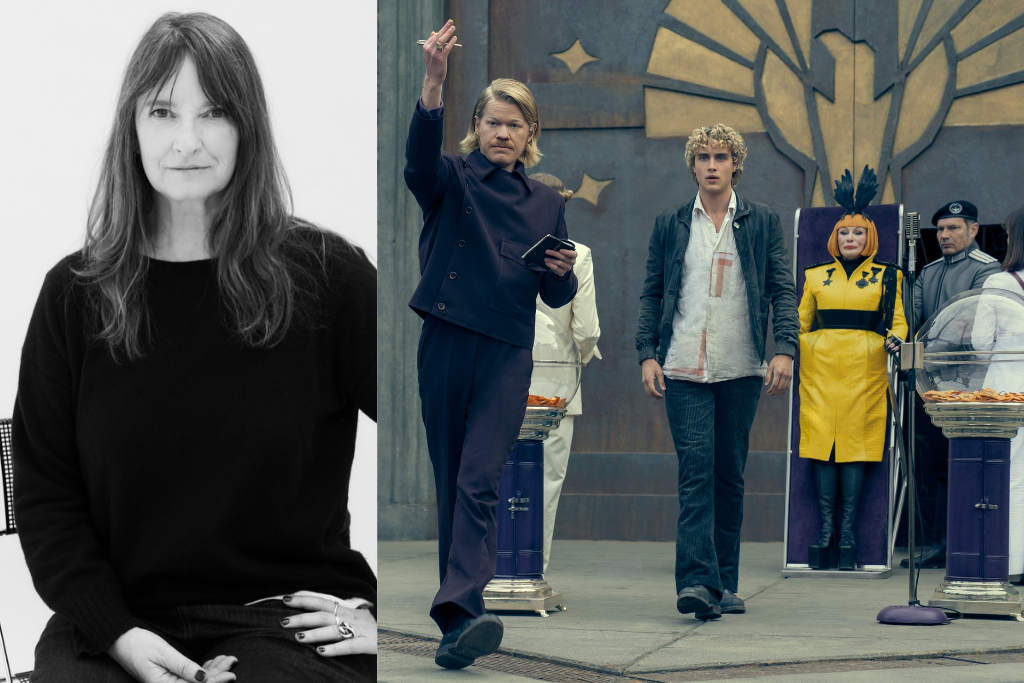
The allure of “The Hunger Games” fashion within the franchise hinges upon its gripping display of dualities that exist within our own reality: the poor and the rich, royalty and workers, the avant-garde and the understated. Even more compelling is the franchise’s fascination with examining how these social codes manifest through fashion. The Capitol turns violence into spectacle, however unsettling, while the franchise’s sartorial world communicates themes of power, privilege and rebellion that have long resonated with fans.
Oscar-nominated costume designer Bina Daigeler was tasked with revisiting the familiar world of Panem 24 years before Katniss Everdeen’s story for the franchise’s latest installment, The Hunger Games: Sunrise on the Reaping. In doing so, she drew inspiration from the glamour of the ’70s, Vivienne Westwood’s designs, and even one of Marilyn Monroe’s most iconic on-screen looks.

The Sitch caught up with Daigeler to discuss the fashion references hidden throughout the film, the complexities of dressing its characters and why, even in a world as dystopian as Panem, there is still room for more fashion fantasy.
The following interview has been edited and condensed for length and clarity.
Hunger Games Fashion: Reimagining Panem
This film takes us back 24 years before Katniss, to a Panem audiences recognize but haven’t seen in this way. How did you approach creating a visual language that feels unmistakably Hunger Games while still belonging to an earlier era?
I definitely took the other Hunger Games movies very seriously, and I take very seriously what it means to be part of a franchise. It has a language that the audience loves and that works, and that is something I wanted to recreate and respect. The audience loves all these characters, so even when you introduce younger versions of them, they still have to have the flavor and the essence of each character.
I got a lot of ideas from the emotions of the other “Hunger Games” movies and, obviously, from the art department, the production design, and Francis’ ideas and vision. It was somehow based on the ’70s and Studio 54. Getting that glamour for the Capitol while staying true to the districts as we already knew them and where they were coming from was very important.

When looking at the Capitol and the districts, clothing almost functions like a class system. What can we learn about who has power in Panem simply by looking at what they’re wearing?
When our District 12 tributes had to go to the chariot scene, all the others were dressed up, but they didn’t have anything. This was a very critical moment because they are our heroes. You don’t want them to look completely poor, but on the other hand, they had to because that was the story. They didn’t have the right thing.
That is when I went for these one-piece pants that have a worker style. On our District 12 tributes, it looked cool, but it didn’t look too powerful. Finding that balance is very tricky. You do a lot of fittings, try things out, and bring a lot of options until you feel that they look very touching to the audience. They look poor, but they still do something emotional to us.
That was a very good example of how we made the difference between the districts. The other districts wore all these bright colors, and you could see that they had everything made for them. They looked just stunning. There was a color scheme for each district that was discussed with Francis, so the color had something to do with the district itself. That was another way to mark the difference.

The Capitol has always been obsessed with making violence look beautiful. When you were designing this film, how did you use fashion to make something disturbing feel seductive?
I think that’s a very good question. I’m very conscious about good patternmaking and tailoring. I take a lot of inspiration from haute couture and fashion designers I love, and I want everything to sit perfectly.
I’m obsessed with fabrics, and I think the choice of fabrics makes even an evil character look attractive. If you have a good pattern, good tailoring and good fabric, they will look good, and they will express what you want to have on screen. These are all things that are very important to me.

There’s something especially cruel about dressing these kids for spectacle before sending them into the arena. Did you ever think about the costumes as another tool the Capitol uses to take ownership of the tributes?
In a way, yes, because you can see how they mistreated District 12 and tried to elevate other districts.
When I work on costumes, sometimes beautiful things happen without having prepared for them. But when you prepare, you try your best to make sure there are no mistakes and that everything has a reason.
With costume design, you have to have a good reason why you dress the actor like that, so that they can feel it and understand the scene better. Everything in costume making should be based on the emotion that’s written in the script. We were lucky that we had a very emotional script, so that was the base.
Fashion can tell us who somebody is, but in The Hunger Games, it can also tell us who somebody is being forced to become. Was there a character where the clothes are almost fighting against that character’s real identity?
I think I would use Plutarch for that because Plutarch is a very, very difficult character. He plays two parts. He has to be in front of the Capitol and in front of Snow, and he leads a double life.
We always had a little bit of a double costume. We had what we called his work outfit that showed a more Capitol, straightforward person, but he also had some more vulnerable and softer costumes for when he was at home, when he was in private. That is, for example, why he was wearing this very soft blue shirt with a square pattern. It gave him much more humanity and showed much more of his inner self.
With Plutarch, that was something we talked a lot about with Jesse. He really wanted to get that into the costume. There’s this depth and the difference between, ‘Now I’m in front of the camera, so to speak, and I’m working, and I’m hiding what I really want to achieve,’ and, ‘Now I’m at home, and I can be more casual, softer and more open.’

The Cultural References Behind Hunger Games Fashion
We’ve heard about some of the ’60s, ’70s and Stevie Nicks references in the film. What’s one fashion, art or cultural reference hidden in these costumes that audiences probably would never guess just from looking at them?
Somehow, I always think that it’s so obvious. Elle Fanning’s Effie Trinket has one costume that is very inspired by Vivienne Westwood, and then there is obviously the inspiration from her butterfly costume in the other Hunger Games movie. Maysilee wears a kind of Marilyn Monroe dress, but in black.
I tried to incorporate some very iconic pieces, and I think the moment when Maysilee is on the stage is so important to show her in glamour and in an iconic look. I thought, okay, I will do a Marilyn Monroe dress, like the white one she’s wearing [in The Seven Year Itch].
I like these little hints. Perhaps the audience doesn’t know it, but it’s there.

Who was the most fun character to dress — the person you felt like you could really push things creatively?
There were so many. I had so much fun doing Effie, but I also had a lot of fun with Glenn Close, and then there was Flickerman. Due to the schedule, I concentrated on Flickerman, then I concentrated on the showgirls. At each moment, the character I was working on was the most fun.
Then there was Magno. Oh my God, I had so much fun with Magno! I could work with so many colors and textures. It was so free that I could combine things, have my own fantasy and just create another world. It’s so rich in costume design that you enjoy each character. It was like, ‘Oh, let’s put more crystals on. Let’s do more feathers.’ We couldn’t stop. It was like, “Hey, we have to finish tomorrow. It’s on camera, so let’s just finish.” But we could never finish.
Even when you look at Snow, he looks so serious. I also love this part. It’s really high-level menswear tailoring. This was based a little bit on the ’40s cut, very uniform-like, so that he feels really strong. The fabrics had a good old wool weight, but then we played and embroidered all his lapels. Suddenly, there’s the fantasy.
Even though it’s wool fabric, this one has more shine; this one has a little stripe. It all came together.

Is there a costume detail — whether fabric, color, accessory or silhouette — that audiences might miss on their first watch that you really want them to pay attention to?
I always think that even when you work on a project where costume design is as prominent as it was in “The Hunger Games,” it should still be a tool.
When you look at Glenn Close, she was wearing so many accessories, but it was all incorporated into her extreme makeup and hair. It came together, and it wasn’t too much. There are so many details and hidden things. It’s not like, ‘Bling, bling, we have this.’ No, it’s just there. For example, Effie Trinket also wears all these butterfly rings. I don’t know if we see them, but we know that they are there.
There are a lot of small, fun surprises, but it always has to be according to the story. It always has to match the background. The costume can be huge because we are on the stage, but then there are other moments where it’s perhaps more quiet.
I’m just trying to make sure that everything comes together in harmony, that the whole image we see on screen comes together and works well. It would be wonderful if the audience finds little surprises. I would love that.

The books sometimes leave room for interpretation. How did you approach translating something like the “handkerchief shirt” from the page into an actual costume?
The audience loves the books, so everything that is written in the book, I tried to recreate in a way that makes sense. For example, the handkerchief shirt that they talk about in the book. There can be a thousand interpretations. What is a handkerchief shirt? There are not a lot of people now who know what an old-fashioned man’s handkerchief looks like.
In my fantasy, I thought, okay, I think that the mother had a very beautiful old linen shirt, but it had holes. So she put the handkerchiefs on top to hide the holes, and then it looked like a cool ’70s patchwork shirt. That was what I based my idea on.
Obviously, another costume designer could have had a completely different interpretation of what a handkerchief shirt is. I don’t know if I accomplished what the audience imagined. That was just my thought behind it.

Of everything you designed for the film, which look do you think fans are going to obsess over the most once they see it?
I don’t know, but I guess Effie, because for me, Effie is a character that could be from any period. She’s somebody who embraces vintage and mismatching. You can just see her joy in dressing up, that you can play, and that this is somehow a form of art.
I think that at the moment, with fashion becoming more gender-free, everything can be much more open. On the street, you see so many different kinds of people, especially when you’re in Berlin or London. It’s so rich. I think Effie is the character who most reflects that because I really mixed all kinds of patterns together and thought, how will that work? But then it worked — flowers, squares — it just worked on her.
I think that is the interesting part about fashion: that it looks fresh, fun, the opposite of sad. The world is already so difficult. Let’s have fun with fashion.

After spending so much time building this version of Panem, what do you think fashion reveals about the Capitol that dialogue alone never could?
When you watch the audience in the stadium with the chariots, you just see that it’s bold, rich, and crazy. You don’t know where they are coming from. You see that there is inspiration from the ’70s, but they all have such an individual, over-the-top style. There’s so much fantasy behind it and so much richness, and it shows an unknown world to everybody.
I think that’s amazing for people to watch. It’s inspiring, fun, and different. I can’t remember seeing something like that with these colors and the way we used costumes. I think it really elevates the scene.
Subscribe to The Sitch Mag’s weekly newsletter here: https://the-sitch-magazine.beehiiv.com/
Leave a Reply